
 Post by
Choosing the right rotary rack oven capacity is an important decision when you are starting a new bakery or expanding an existing one. Your oven directly affects your daily production, baking time, product quality, energy consumption, and overall workflow. This is why you should not simply choose the biggest bakery oven available or select a model based only on its price or tray capacity.
To choose the right oven, you first need to understand how much you plan to produce every day and what type of bakery products you will manufacture. Bread, buns, cookies, cakes, pastries, pizza bases, and other products may have different baking requirements. You should also consider the number of batches you need to complete, your bakery’s working hours, available installation space, heating requirements, and expected business growth.
For a new bakery, estimating future production can be difficult. You may start with a smaller production volume but expect orders to increase as your business grows. Therefore, selecting an oven with practical additional capacity can help you avoid replacing your equipment too soon.
At Anmol Bakery Machines, we understand that every bakery has different production requirements. We help you consider your production volume, product range, available space, workflow, and future expansion plans before selecting suitable bakery machinery. In this blog, we will talk about the key factors you should consider when choosing the right rotary rack oven capacity for your bakery.
Tips – How to Choose the Right Rotary Rack Oven Capacity
The right capacity of a rotary rack oven depends mainly on how much you need to bake in one cycle and how many baking cycles you can run during your working hours or per day.
For example, if your bakery needs to produce 500 bread loaves per day and your selected oven can accommodate the required quantity in five batches, you need to check whether those five batches can realistically be completed within your production schedule.
Instead of looking at tray numbers alone, consider the complete production requirement:
| Factor | What You Should Consider |
| Daily production | How much you need to bake each day |
| Product range | Bread, buns, cookies, cakes, pastries, etc. |
| Tray capacity | Number and size of trays per batch |
| Baking time | Time required for each product |
| Working hours | Total time available for baking |
| Available space | Space for installation and operation |
| Future growth | Expected increase in production |
| Energy source | Electricity, gas or other available option |
| Budget | Purchase and long-term operating costs |
This approach will help you select a commercial bakery oven that matches your actual business requirements rather than buying based only on capacity numbers.
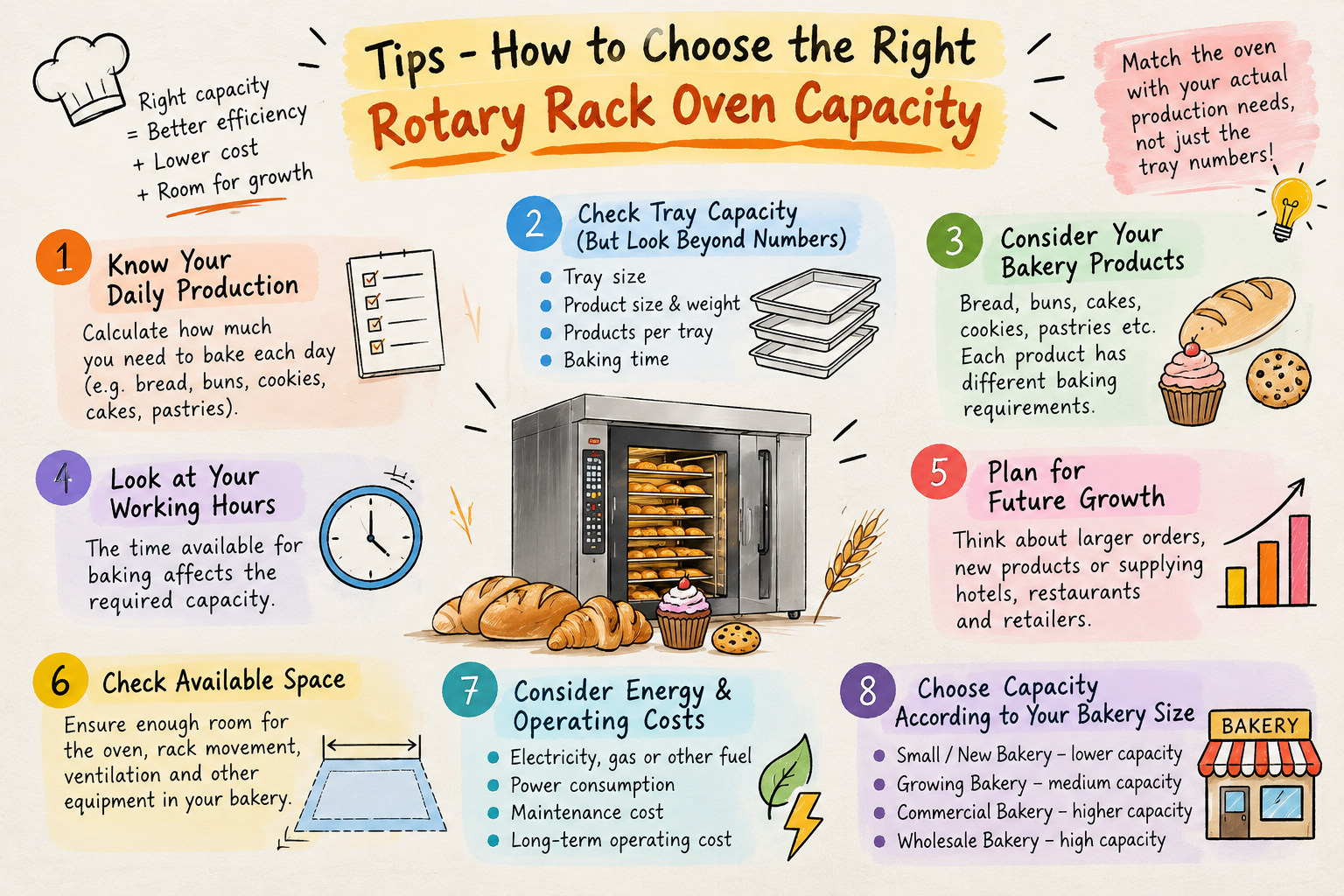
Key factors to consider when selecting rotary rack oven capacity for your bakery
1. Start With Your Daily Production Requirement
Before selecting a rotary rack oven, calculate how much you expect to produce every day. If you already operate a bakery, you can use your current sales and production records. If you are starting a new bakery, prepare an estimated production plan based on your expected customers and orders.
For example, you may plan to produce:
- 500 bread loaves per day
- 300 buns
- 20 kg of cookies
- 50 cakes
- 200 pastries
You should then determine how many products can be baked in one cycle and how many cycles you will need to complete your daily production.
This is particularly important for a new bakery owner, because buying an oven with much more capacity than your actual requirement can unnecessarily increase your initial investment.
2. Understand Tray Capacity
Rotary rack ovens are commonly available in different tray capacities. Depending on the manufacturer and model, you may find options such as 16-tray, 32-tray, and 64-tray ovens. However, tray capacity alone should not determine your purchase decision.
The actual output also depends on:
- Tray dimensions
- Product size
- Number of products per tray
- Product weight
- Required spacing
- Baking temperature
- Baking time
For example, two ovens may both be advertised as 32-tray ovens but have different tray dimensions and technical specifications. Therefore, always compare the complete machine specifications before making your decision.
3. Consider the Type of Bakery Products You Make
Your product range also influences the type and capacity of oven you need. A bakery mainly producing bread and buns may have a different production requirement from a bakery specialising in cakes, cookies or pastries. Similarly, a wholesale bakery supplying restaurants and retailers may require considerably more production capacity than a small retail bakery.
Make a list of the products you intend to manufacture and discuss their baking requirements with your bakery oven manufacturer. This will help you understand whether a particular rotary oven for bakery applications is suitable for your production process.
4. Consider Your Working Hours
Your working hours can significantly affect your required oven capacity. Imagine two bakeries need to produce the same quantity of bread every day. One bakery operates for 10 hours, while the other has only 6 hours available for production. The second bakery may require faster production or greater oven capacity to achieve the same daily target. Therefore, when choosing your commercial bakery oven, consider both your daily production and the amount of time available to complete it.
5. Keep Future Growth in Mind
If you are starting a bakery, you should not plan only for your first few months of production. Your business may grow as you gain customers and receive larger orders.
Think about whether you may eventually:
- Supply hotels and restaurants
- Take bulk orders
- Supply retailers
- Add new bakery products
- Increase daily production
- Open another outlet
- Expand into wholesale production
You do not necessarily need to buy the largest industrial bakery oven from day one. However, choosing a machine with reasonable additional capacity can prevent your bakery from becoming dependent on multiple small baking cycles as your business grows.
6. Check the Available Space in Your Bakery
Before finalising an oven, measure your bakery space carefully.
You need enough room not only for the oven itself but also for loading, unloading, movement of racks, ventilation, electrical or fuel connections, and maintenance. Your complete bakery layout should also accommodate other essential equipment such as mixers, proofers, worktables, cooling areas and packaging equipment. A well-planned layout can improve workflow and make your bakery operation more efficient.
7. Consider Energy Requirements and Operating Costs
The purchase price is only one part of the cost of owning a bakery oven. You should also consider its ongoing energy requirements. Depending on the model and configuration, bakery ovens may use different heating systems. When comparing machines, ask your manufacturer about:
- Power requirements
- Fuel consumption
- Heating system
- Temperature control
- Operating cost
- Maintenance requirements
- Installation requirements
Choosing an oven based on both purchase price and long-term operating requirements can help you make a more practical investment.
8. Choose the Oven Capacity According to Your Bakery Size
As a general starting point, you can think about oven capacity in terms of your business scale:
| Bakery Type | Capacity Consideration |
| Small/new bakery | Lower or medium capacity depending on expected production |
| Growing bakery | Medium capacity with room for increased production |
| Commercial bakery | Higher capacity based on daily production |
| Wholesale bakery | High-capacity equipment designed for continuous production |
These are only general guidelines. Your actual requirement should be calculated according to your products, batch size, baking time and daily production target.
Don’t Choose Your Oven in Isolation
Your rotary rack oven should work efficiently with the rest of your bakery machinery. For example, if your oven can bake a large quantity in every cycle but your dough mixer cannot prepare enough dough, the mixer becomes a production bottleneck. Similarly, inadequate proofing or packaging capacity can slow down the complete production process. Therefore, when planning a bakery setup, consider your machinery as a complete production system.
At Anmol Bakery Machines, we offer bakery machinery solutions including rotary rack ovens, spiral mixers, planetary mixers and cookie depositor machines. We can help you look at your complete production requirements rather than focusing on only one machine.
Common Mistakes to Avoid
Many bakery owners make one of the common mistake of selecting an oven only by its price range or tray capacity. This can later create problems.
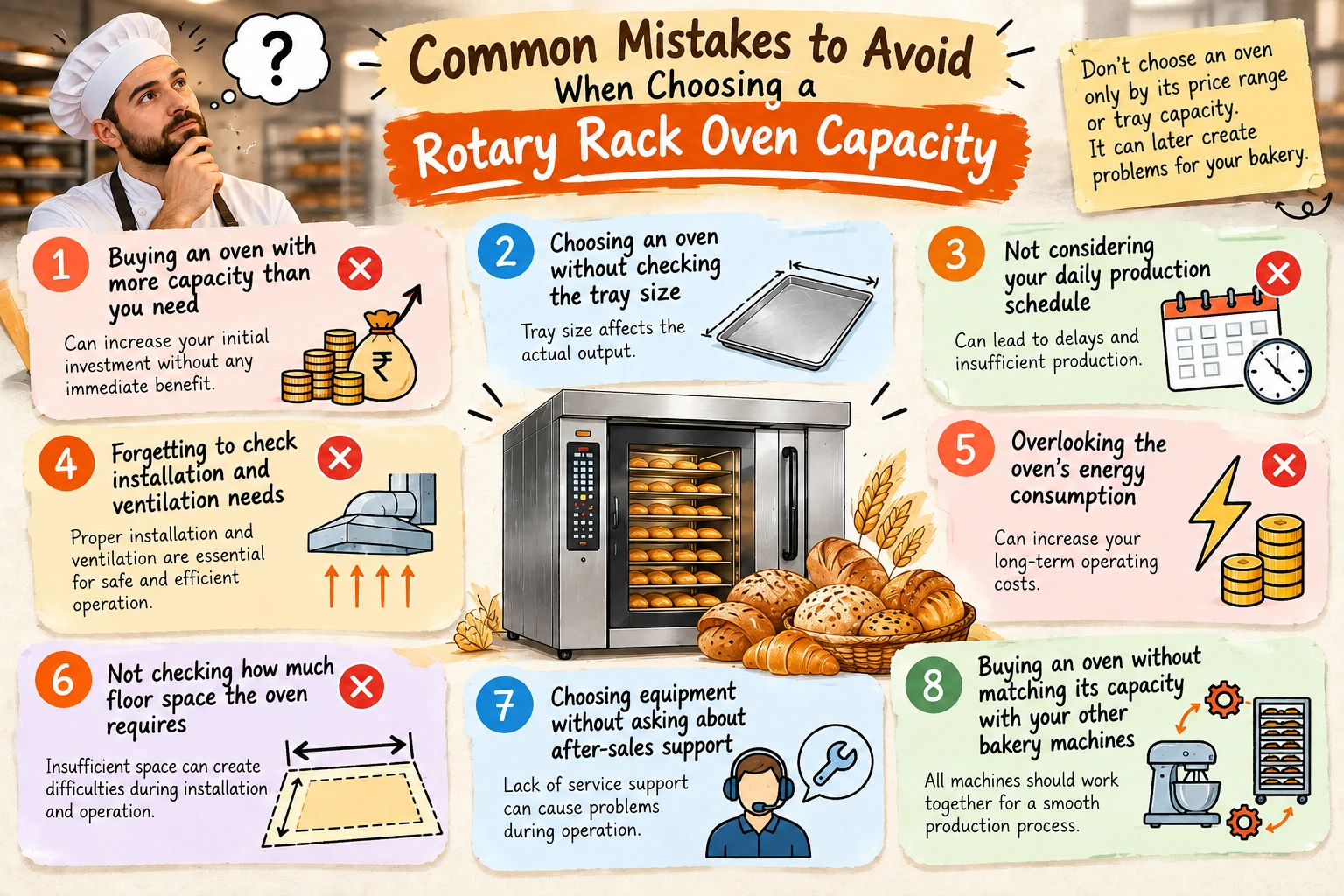
Avoid:
- Buying an oven with more capacity than you need without planning for future growth
- Choosing an oven without checking the tray size
- Not considering your daily production schedule
- Forgetting to check installation and ventilation needs
- Overlooking the oven’s energy consumption
- Not checking how much floor space the oven requires
- Choosing equipment without asking about after-sales support
- Buying an oven without matching its capacity with your other bakery machines
A proper discussion with an experienced bakery machinery manufacturer can help you avoid these problems.
Why Choose Anmol Bakery Machines?
With 13+ years of experience in bakery machine manufacturing, at Anmol Bakery Machines, we understand that every bakery has its own production requirements. Whether you are setting up your first bakery, upgrading an existing production unit, or expanding into commercial baking, we help you select machinery according to your actual needs.
Since 2013, we have completed 500+ bakery machine deliveries with 100% customer satisfaction. Our bakery machinery range includes rotary rack ovens, spiral mixers, planetary mixers, cookie depositor machines and other bakery equipment. We focus on providing practical solutions for bakery businesses while considering production capacity, workflow, space and future requirements.
If you are unsure which oven capacity is right for your bakery, you can discuss your expected production with our team before making your purchase. This allows you to compare suitable options and plan your bakery machinery investment more effectively.
Final Thoughts
Choosing the right rotary rack oven capacity for your bakery means finding a good balance between your production needs, budget, available space, and future business growth.
Do not choose an oven just because it offers more trays. First, understand how much you need to produce, how many batches you can bake, what products you plan to make, how much space is available, and how your bakery may grow over time.
With proper planning, the right oven can become an important part of a smooth and efficient bakery production process.
If you are looking for a reliable bakery oven manufacturer in India, Anmol Bakery Machines can help you find the right bakery machinery solutions. From rotary rack ovens to mixers and other bakery equipment, we understand your requirements and provide machinery that fits your bakery setup.
Planning to start a new bakery or upgrade your existing bakery? Contact Anmol Bakery Machines to discuss your production needs and choose a bakery oven that works well for your business.